

Flying Spur’s Mahuta Shines in Sandown Guineas
Updated: November 15, 2015 at 3:43 pm
By John Berry
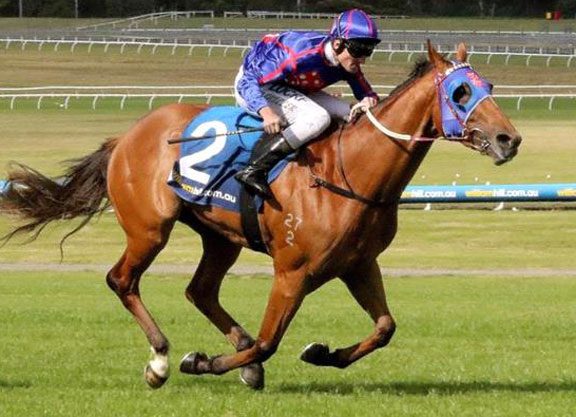
Over the past fortnight, many of the major European studs have released their fees for the 2016 breeding season. One eye-catching aspect of the rosters is the proliferation of reverse-shuttling stallions.
Shuttling sires from the Northern Hemisphere to the south has been commonplace now for nearly 30 years, but it took longer for the reverse process to be accepted. However, with at least a dozen Australasian horses listed on the major rosters in the British Isles for the forthcoming stud season, it is clear that the reverse-shuttle regime is now firmly established.
It was not until Choisir (Aus) (Danehill Dancer {Ire}) had altered European perceptions of the merits of Australian horses by winning twice at Royal Ascot in 2003, that the reverse-shuttle route started to become a viable one. Those who had tried it previously had found their efforts unappreciated, and several good sires came and went without much in the way of either fanfare or thanks. One of ‘the ones who got away’ was the one-time Irish National Stud visitor Flying Spur (Aus) (Danehill), and the impressive victory of his son Mahuta (Aus) in the G2 Sandown Guineas, has provided us with yet another reminder of what he had to offer.
Any overview of the history of dual-hemisphere sires has to revolve around Danehill (Danzig) ,who was one of the best sprinting colts in Europe in 1989 prior to becoming the only sire in history to top the General Sires’ Table both in Great Britain/Ireland and in Australia.
Flying Spur was one of the Australian horses who helped to establish Danehill’s merit. One of Danehill’s most notable achievements was to sire a G1 Golden Slipper winner with each of his first three Australian crops. The first two were colts–Danzero (Aus) and Flying Spur–while the third was the filly Merlene (Aus). Both colts retired to Arrowfield, and both took the reverse-shuttle route at some point. Flying Spur was the first one with whom this bold venture was tried: after his first season at Arrowfield in 1996, he headed up to the Irish National Stud for the 1997 breeding season before repeating the exercise in the next two years.
It is safe to conclude that Flying Spur, rather than Danzero, was chosen first to tread this path because, while Danzero hailed from an Australian family, Flying Spur was a son of the U.S.-bred Mr. Prospector mare Rolls, a granddaughter of the top-class racemare and broodmare Fanfreluche (Northern Dancer).
Sadly, Flying Spur’s three terms at the Irish National Stud saw him poorly patronized, even at the low fee of IR£5,000. This was before Danehill had gained the exalted reputation in Europe which he ultimately established; before Choisir had opened European eyes to the merit of Australian sprinters; and before the internet had enabled breeders to know what was going on in other parts of the world. The experiment was consequently discontinued after the 1999 season–and it was only after Flying Spur had gone that it became clear how effectively he had been upgrading his mares there.
The terrific sprinters whom Flying Spur left behind from his Irish National Stud days included the group winners Osterhase (Ire), Steenburg (Ire) and Volata (Ire). The last-named, incidentally, is probably best known by the name which he adopted in Hong Kong, where he won the G1 Centenary Sprint Cup at Sha Tin as Firebolt (Ire).
Flying Spur went on to prove himself one of the best sires in Australia, most notably topping the General Sires’ Table in 2006/’07 when his stars included G1 Golden Slipper winner Forensics (Aus), G1 Blue Diamond S. winner Sleek Chassis (Aus) and G1 Randwick Guineas winner Mentality (Aus). Although now aged 23 and retired from active duty, Flying Spur is still coming up with good horses. The progressive Mahuta is the latest.
Although bred in Australia from a New Zealand-bred mare, Mahuta comes from a family which, until his American-bred granddam Sharpatan (Diesis {GB}) was exported from the United States to New Zealand, had been resident in the States for nearly a century.
Mahuta’s fourth dam Miss Toshiba (Sir Ivor) was a star both on the racecourse and at stud. Owned by Robert Sangster, she scored in Group 2 company in Ireland (in the Pretty Polly S. in 1975) and at Grade I level in California (in the Vanity H. in 1976).
Miss Toshiba came from the immediate family of 1944 GI Belmont S. winner Bounding Home (Espino) and was a half-sister to Mistinguette (Boldnesian), dam of the top-class Irish-trained sprinter Committed (Hagley). Hence it was unsurprising that she did well at stud, where her best daughters were the stakes-winning Northern Dancer filly Northeastern and the Group 1-placed Kris (GB) filly Guilty Secret (Ire). Both became decent broodmares, while another of Miss Toshiba’s daughters, the winning Sadler’s Wells filly Ikebana (Ire), bred the 1998 G1 Derby runner-up City Honours (Darshaan {GB}).
Another of Miss Toshiba’s grandchildren was Mahuta’s second dam, the stakes-placed Diesis (GB) filly Sharpatan. She spent her stud career in New Zealand, where she produced five winners headed by her Sir Tristram filly Isolda (NZ), a Group 1 winner as a 2-year-old in Australia in the 1994/’95 season before finishing third in the G1 AJC Oaks during the following campaign. Isolda bred the Group 3-winning Redoute’s Choice (Aus) horse Bid Spotter (Aus), while other stakes-winners descending from Sharpatan include Jolie Blonde (Aus) (Testa Rossa {Aus}) and Listen Son (Aus) (Big Jesse {Aus}).
Mahuta now ranks as the latest stakes winner to descend from Sharpatan, and he is bred on very similar lines to Bid Spotter: his unraced dam Vahine (NZ) is a three-parts sister to Isolda (being by Sir Tristram’s son Zabeel {NZ}) while his sire Flying Spur and Bid Spotter’s sire Redoute’s Choice (Aus) are both sons of Danehill.